
Astronomy Chart
Step outside and wonder which bright star that is? This chart draws the sky above your location for any date and time: the brightest stars sized by brightness, familiar patterns such as the Big Dipper and Orion, and the Moon and planets. Hold it overhead with the direction you face at the bottom, and it matches the sky. Print it for a night of stargazing.
- Free to use
- No sign-up
- Runs in your browser
Sky chart
Stargazing Printables
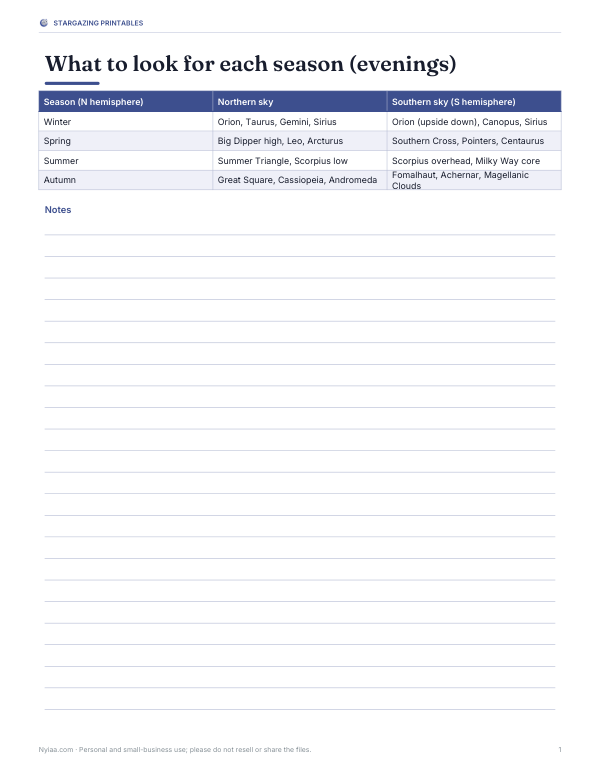
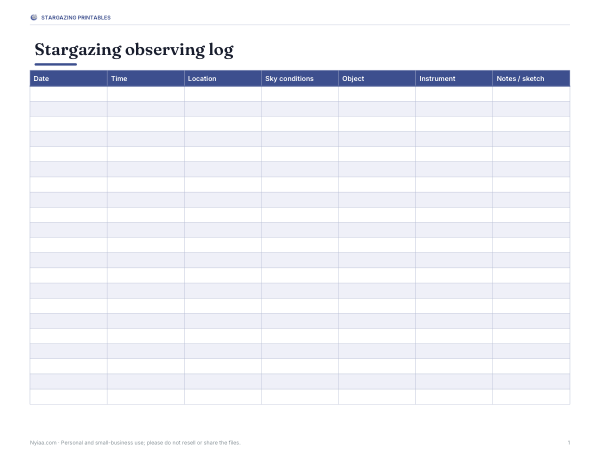
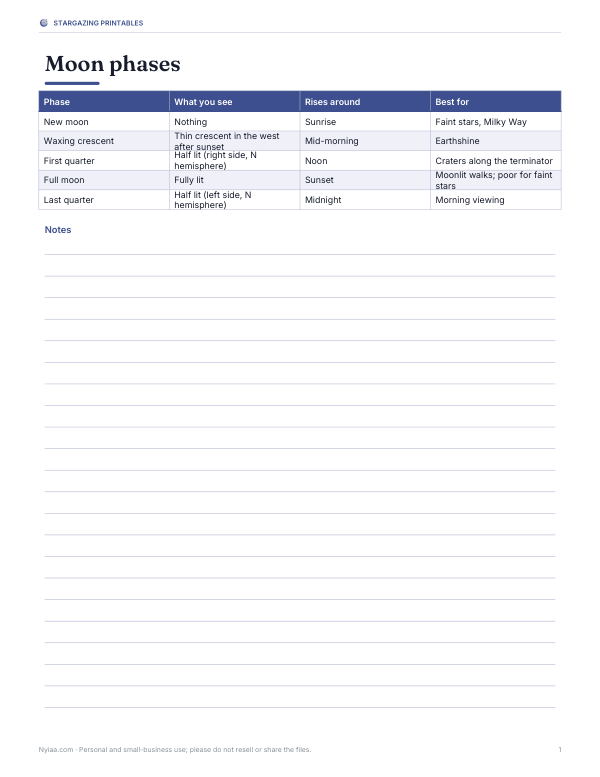
Printable seasonal star-pattern guides for both hemispheres, a Moon phase calendar sheet, an observing log and a stargazing checklist.
- Seasonal patterns (PDF/XLSX)
- Observing log (PDF/DOCX/XLSX)
- Moon phases (PDF)
- Checklist (PDF/DOCX)
Formats: PDF, XLSX, DOCX. Instant download after payment (link valid 72 hours, up to 5 downloads). AI-assisted: the templates were drafted with AI help and reviewed and laid out before publishing.
$3.00 USD, one-time 4 files · about $0.75 each
- Instant download
- 7-day refund
- Secure checkout by Stripe
7-day money-back guarantee. Full refund within 7 days of purchase, even after you download.
Free sample: Moon Phase Sheet (PDF, 69 KB)
Full refund within 7 days — see the refund policy and license.
Free printables
Single sheets you can print right now, no sign-up. The full pack adds every sheet in one download plus the editable files.
 Printable Stargazing Checklist
How to read the sky chart
- The circle is the whole visible sky. The centre is straight overhead (the zenith); the edge is the horizon.
- Compass letters around the edge show directions. East and west look swapped compared with a map because you’re looking up, not down.
- Face a direction and hold the chart overhead with that letter at the bottom — the stars above that horizon now match.
- Bigger dots are brighter stars. Lines join stars in familiar patterns.
- The Moon and bright planets are labelled in colour; the table lists altitude (height above the horizon) and direction.
Star patterns to start with
| Pattern | Best seen (northern mid-latitudes) | Tip |
|---|---|---|
| Big Dipper (Plough) | All year; high in spring evenings | The two end stars of the bowl point to Polaris, the North Star |
| Cassiopeia | All year; high in autumn | A W or M shape opposite the Big Dipper across Polaris |
| Orion | Winter evenings | Three belt stars in a row; red Betelgeuse and blue-white Rigel |
| Summer Triangle | Summer and autumn evenings | Vega, Deneb and Altair — three bright stars in different constellations |
| Great Square of Pegasus | Autumn evenings | A large square of four fairly bright stars |
| Southern Cross | Southern hemisphere, especially autumn–winter | Four bright stars; use it to find the south celestial pole |
Worked example: finding Polaris
From a northern mid-latitude such as New York (40.7° N) on a spring evening, the Big Dipper is high in the north. Draw a line from Merak through Dubhe — the two stars at the end of the bowl — and continue about five times that distance to reach Polaris, which sits about 40° above the northern horizon. Polaris’ altitude is always close to your latitude, which is why sailors used it to find their position.
Planets and the Moon
Planets move against the stars, so they are calculated for your date. Venus is usually the brightest “star” in the west after sunset or the east before sunrise; Jupiter is steady and bright; Mars has a reddish tint; Saturn is fainter and yellowish. Planets tend to shine steadily while stars twinkle, especially near the horizon. The Moon’s brightness can wash out fainter stars — the best stargazing is around new moon.
Star brightness and colour
Astronomers measure brightness in magnitudes: the smaller the number, the brighter the star, and each step of one magnitude is about 2.5 times brighter. Sirius is magnitude −1.5; the faintest stars visible from a dark site are around magnitude 6, while in a city you may only see magnitude 2–3. Colour hints at temperature: blue-white Rigel and Vega are hotter than yellow-white stars like the Sun, while orange Arcturus and red Betelgeuse and Antares are cooler.
Why the sky changes
- Through the night, the sky turns around the celestial pole — about 15° an hour — so stars rise in the east and set in the west.
- Through the year, the same stars rise about four minutes earlier each night, so each season shows different constellations in the evening.
- Your latitude decides which stars you can see: near the North Pole the same stars circle all night; near the equator you can see both hemispheres’ stars over the year.
- Planets wander slowly along the ecliptic, the band where the Sun and Moon also travel.
Star hopping
Star hopping means using bright stars you know to find ones you don’t. From Orion’s belt, follow the line down-left to Sirius and up-right to Aldebaran and the Pleiades. From the Big Dipper’s handle, “arc to Arcturus and speed on to Spica”. In the southern sky, the two Pointers (Alpha and Beta Centauri) lead to the Southern Cross.
Getting ready to stargaze
- Check the weather and moon phase; pick a dark site away from streetlights.
- Let your eyes adapt for 15–20 minutes and use a red light to read the chart.
- Start with the brightest stars and patterns, then hop to fainter ones.
- Binoculars show star clusters like the Pleiades beautifully.
- Dress warmly — even summer nights get cool when you’re standing still.
About the calculations
Star positions come from standard catalogue coordinates for the brightest stars and are converted to altitude and azimuth using your latitude, longitude and local sidereal time. The Sun, Moon and planets are computed with published astronomical approximations. Because of precession and simplified models, positions are accurate to well within a degree — plenty for finding objects by eye.
Printable stargazing pack
The optional pack includes printable seasonal star charts for the northern and southern hemispheres, a Moon phase calendar sheet, an observing log and a red-light-friendly checklist. The interactive chart above is free.
AI-assisted content
This page was drafted with AI assistance and reviewed before publishing.
Frequently asked questions
How do I use a star chart?
Hold it overhead with the direction you face at the bottom; the centre is straight up.
What is the brightest star in the night sky?
Sirius, in Canis Major.
How do I find the North Star?
Follow the two end stars of the Big Dipper’s bowl about five times their separation.
How can I tell a planet from a star?
Planets shine steadily and move over weeks; stars twinkle and keep their patterns.
When is the best time for stargazing?
On clear nights around new moon, away from city lights.
Why are east and west reversed?
Because the chart shows the sky looking up, not the ground looking down.
What does magnitude mean?
A measure of brightness where smaller numbers are brighter; each step is about 2.5 times.